
 Image 1 of 1
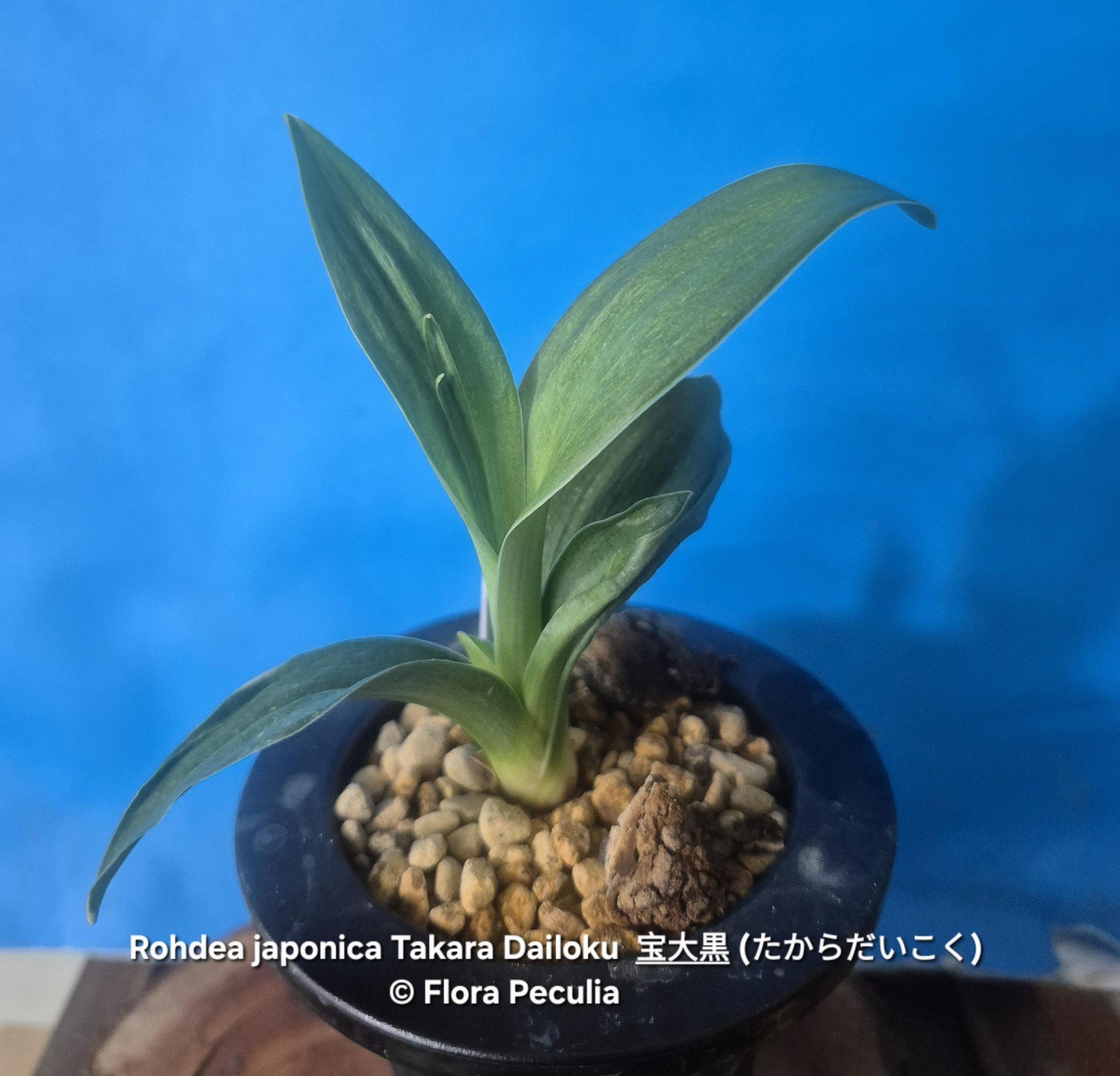
Omoto Takara-Daikoku (宝大黒) is a rare, highly collectible medium-sized Japanese Sacred Lily (Rohdea japonica) that belongs strictly to the Rasha (羅紗) group, celebrated for its thick, heavily textured foliage. This classic cultivar was originally bred in 1970 (Showa 45) by Hiroaki Shigematsu in Nagoya, Japan, and formally registered in 2017 (Heisei 29). Today, it remains highly scarce globally due to a decreasing population among growers and its reliance on slow, traditional nursery division rather than mass lab propagation. Visually, the plant produces broad, plump, forest-green leaves with a Marudome (blunt, rounded tip) that display an Oshisage habit, meaning they gently curve downward toward the container to create a squat, high-volume, and deeply balanced silhouette. A true specimen is defined by its complex leaf arts (gei), featuring strong Gashiryu (dense, fine raised ridges running lengthwise along the leaf), Noshiha (inward folding of the leaf sides like ceremonial paper), and sharp Tankenba (dagger-like short leaves) that create intense structural depth.
Omoto matures with age, displaying stronger characteristics each year. A sight to behold as they change.
Omoto Takara-Daikoku (宝大黒) is a rare, highly collectible medium-sized Japanese Sacred Lily (Rohdea japonica) that belongs strictly to the Rasha (羅紗) group, celebrated for its thick, heavily textured foliage. This classic cultivar was originally bred in 1970 (Showa 45) by Hiroaki Shigematsu in Nagoya, Japan, and formally registered in 2017 (Heisei 29). Today, it remains highly scarce globally due to a decreasing population among growers and its reliance on slow, traditional nursery division rather than mass lab propagation. Visually, the plant produces broad, plump, forest-green leaves with a Marudome (blunt, rounded tip) that display an Oshisage habit, meaning they gently curve downward toward the container to create a squat, high-volume, and deeply balanced silhouette. A true specimen is defined by its complex leaf arts (gei), featuring strong Gashiryu (dense, fine raised ridges running lengthwise along the leaf), Noshiha (inward folding of the leaf sides like ceremonial paper), and sharp Tankenba (dagger-like short leaves) that create intense structural depth.
Omoto matures with age, displaying stronger characteristics each year. A sight to behold as they change.